
A note before we start: I wrote this in Japanese in 2020, when I had to rewatch Floating Clouds for work and ended up reading the screenplay again. I’m bringing it over here almost as it was. Six years on, I noticed that Yukiko — a woman the world had no use for — was already the kind of character I now want to spend my career making room for. Spoilers throughout. It’s a masterpiece; knowing the ending doesn’t spoil anything.
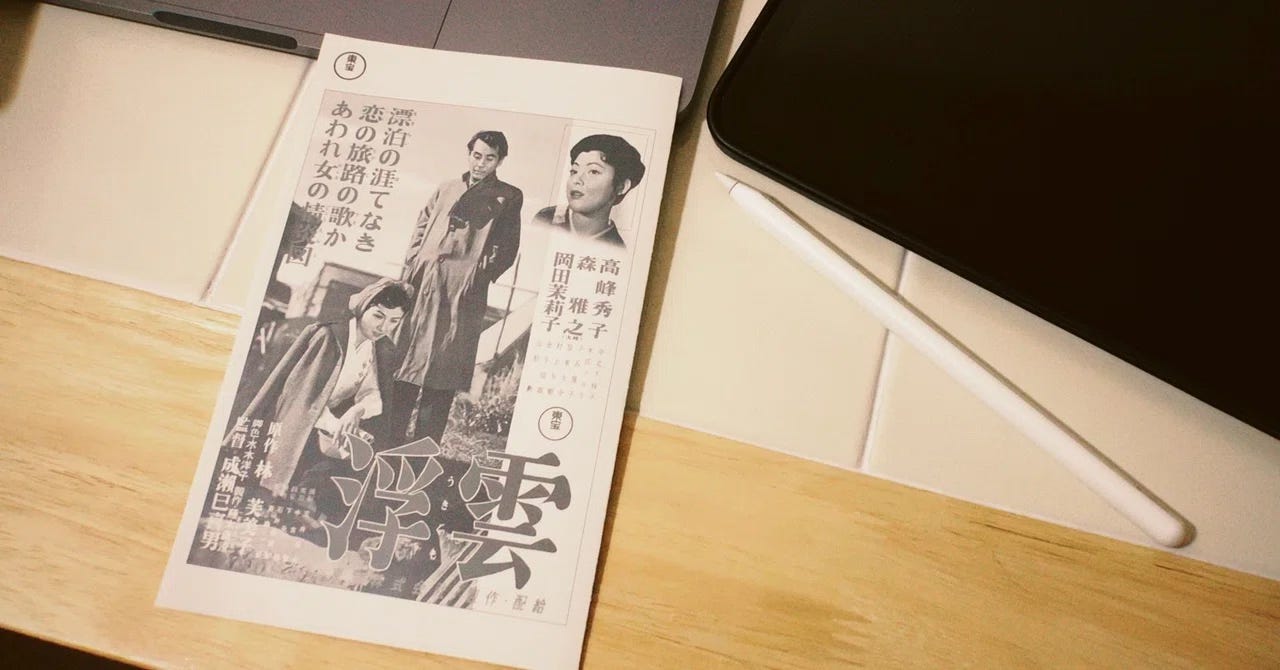
Floating Clouds (浮雲, 1955) is one of my all-time top ten. On the surface it’s a love story about a useless man and the woman who can’t stop loving him. It is also one of the great road movies ever made.
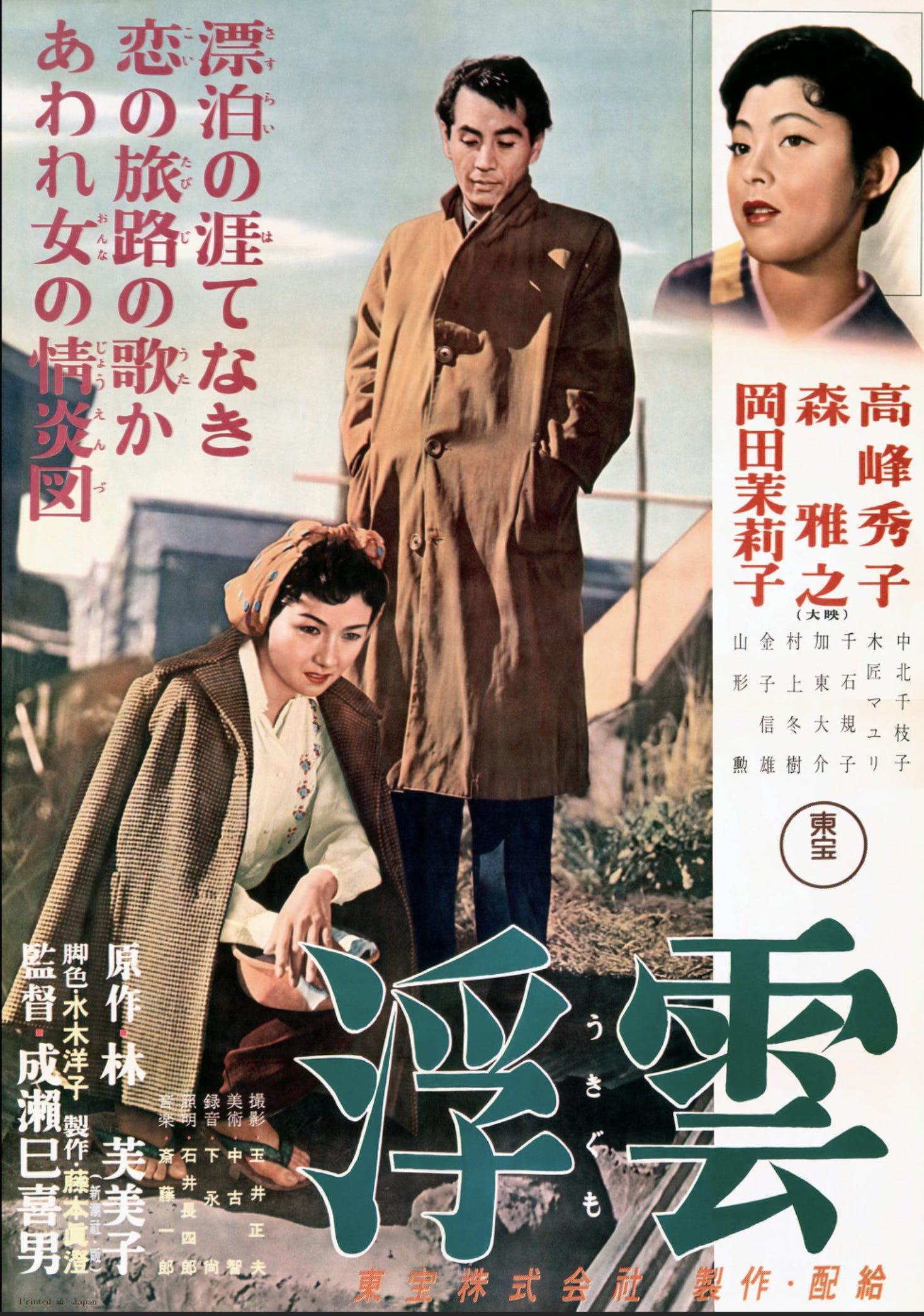
Floating Clouds (1955) Director: Naruse Mikio Based on the novel by: Hayashi Fumiko Screenplay: Mizuki Yōko Assistant director: Okamoto Kihachi Music: Saitō Ichirō Cinematography: Tamai Masao
Kōda Yukiko — Takamine Hideko Tomioka Kengo — Mori Masayuki Sei — Okada Mariko Iba Sugio — Yamagata Isao Kuniko, Tomioka’s wife — Nakakita Chieko
Japanese names are given surname first.
The whole thing in one line: during the war, a woman falls violently in love with a married man, and neither of them can cut the cord — a film that asks what, exactly, we mean by pure love.
Let me get my bias out of the way. Tomioka is an adulterous piece of work, personally the type of man I loathe most. But the film’s rendering of Yukiko’s helplessness — the sheer nothing-to-be-done of loving a man like this — is extraordinary. And Tomioka, for all his selfishness, is completely dependent on her. Please don’t write it off as “a story about a deadbeat man and a codependent woman.” The tangle of their obsessions is so intricate that simply taking it apart makes you go: God, cinema is incredible.
Structure and plot points
To take it apart, I broke it into three acts. This is my own reading, not gospel.
Act One: The reunion
1-1 — The memory of romance, and its collapse. 1943. Yukiko goes to French Indochina as a typist for the Ministry of Agriculture and Forestry, meets Tomioka, a government official, and falls hard. He promises to divorce his wife and returns to Japan ahead of her.
1-2 — Reunited, and already missing each other. The war ends. She turns up at his house. He is living an ordinary life with his wife. The wreckage of postwar Japan has cooled something in him. Yukiko learns he has no intention of leaving.
Act Two: The two who can’t separate
2-1 — Yukiko goes under; Tomioka’s childish jealousy. Yukiko becomes a pan-pan girl — a prostitute working the Occupation soldiers. Tomioka shows up and attacks her for it, entirely on his own terms. Neither of them can end it.
2-2 — Sei appears. Tomioka floats; Yukiko panics. They go to a hot spring town, Tomioka talking about a double suicide. There he takes up with Sei, another man’s wife. Yukiko sees it, and something inside her starts to give way. She discovers she’s pregnant, goes to find him, and finds him living with Sei.
2-3 — Sei’s death, Yukiko’s abortion, Tomioka’s apathy. Yukiko borrows money from Iba — her brother-in-law, the man who once raped her — and terminates the pregnancy. Tomioka tells her Sei has been killed by her husband. Yukiko imagines the two of them consoling each other, his loss and hers. Tomioka is worried about how it looks.
Act Three: Toward the parting
3-1 — The wife dies; Yukiko follows him. Tomioka tells Yukiko his wife has died. He’s been posted to Yakushima. She decides to go with him.
3-2 — Yukiko dies; Tomioka is left. She falls ill on the long journey south. He nurses her with a devotion he has never once shown before. She dies. Doing her death-makeup, he breaks open for the first time in the entire film.
The scenes I keep coming back to
Act One / 1-2, Scene 15 — the Hotei Hotel, near the Ikebukuro black market
The two of them talk about Da Lat. He bites her fingers. Softened by him, Yukiko mourns what she’s become — “look at the woman I’ve turned into” — even as she sinks into the sweetness of the memory. Tomioka: there’s no use thinking about the past forever. Yukiko, flaring: for you and me, the past is everything.
She’s still dragging the good life behind her; he’s gone inert in the face of the postwar present. Confronted with her jealousy, he tells her the truth as he understands it — that he loves her, and that not being able to be with her is his own weakness — and then he tries to give her money. She’s wounded, and what comes out of her mouth is a brush-off: men are liars. End of scene. It’s the purest distillation of his uselessness, and of her inability to cut him loose. It hands you straight into Act Two.
Act Two / 2-2, Scene 62 — the storeroom
They came to the hot spring together and he’s slept with Sei. Yukiko’s panic and disgust are all over her face. He slides around her jealousy, cheerful, evasive; when she looks at him with exhaustion he tries to charm her back with something like let’s just go our own way, shall we — tossing off the title of a Bing Crosby picture. And Yukiko says it: I feel sick.
She means it. And I think, simultaneously, she is helplessly in love with this man, both things living in her at once. The screenplay knows it. After that line, the action direction reads: Yukiko stays face-down on the tatami for a long moment — her shoulders working with her breath.
Act Two / 2-3, Scene 79 — Sei’s room
Yukiko has learned Sei is dead and comes to him, I think, believing their wounds can meet. Instead he is indifferent to her abortion and says something unforgivable: you must be pleased. He can grieve Sei out loud; for what Yukiko has just been through he offers money and nothing else. Then he produces the great self-serving absolution — it’s all my fault — kindness and ego welded into one sentence. What she can’t stand is his feeling for Sei. I won’t lose to that woman even in death, she says, and collapses, hyperventilating. Then the two of them circle each other, standing, turning away, taking each other’s hands. And Yukiko leaves.
This scene is a monster. There is something about a woman terminating a pregnancy that language can’t reach, and on top of that unreachable thing the film stacks her hope for him, her honesty, and her rage at a dead woman. And he’s a waste of a man, but he’s also in shock that the woman he loved has been murdered, and eaten alive by his own uselessness. There’s nothing to be done. Nothing. If those two were standing in front of me I would separate them with everything I had. God, it hurts.
And then Naruse cuts, mid-scene, to children playing outside. One shot. The life Yukiko has just lost, rendered as grief through nothing but a few seconds of oblivious children.
Act Three / 3-2, Scenes 144, 145, 146 + 149 — the official residence on Yakushima
Yukiko is badly weakened by the journey. She finally has the world reduced to the two of them, and he nurses her tenderly, and she is — briefly — safe. Then she watches him stop to talk with Nobu, the housemaid, on his way up the mountain to work.
She can’t hold the anxiety down. The direction reads: she tries to say something, but the coughing takes her. Look at that line. Death is right there in the room, and she is still the person who knows better than anyone what this man is — so even a maid is a threat. Then in 149 she gets up, unsteady, to close a window the storm is blowing rain through. The noise of it against the shutters is enormous, and it plays like her obsession made audible. And then she dies. By 153 he’s rushed back and she’s already gone — and you’re left with everything she might have been thinking at the end.
The death-makeup, and the flashback — Scenes 156, 157 — Da Lat
After 155, where he finally breaks and does her death-makeup, Tomioka sees Yukiko in Da Lat: beautiful, alive, burning.
In 157 she’s in a white blouse, framed straight on, chest-up, smiling. Two questions came at me out of that shot.
First: in the end, did Yukiko ever actually get his love?
Second: can we say Tomioka loved her at all?
Maybe Yakushima gave her happiness, that time alone with him. But at the very end — did she die feeling loved, or did she die inside the same helpless anxiety she’d carried the whole way? And he nursed her, he was gentle with her, but was that love, or was it restitution for everything he’d done? And even if he did love her — didn’t he only notice after she was dead?
That’s what the film does. Scene construction, dialogue, gesture, cutting — every detail is aimed at churning up your feelings and then throwing a question at you as it ends. Extraordinary picture.
Finally
Read Mizuki Yōko’s screenplay if you can get hold of it. The inserted cutaways, the use of flashback — the reasons for all of it are on the page. The action directions are written tight enough that you can read off exactly why the performance has to be that performance. It is the clearest proof I know that a screenplay is a film’s load-bearing frame, and a precision blueprint.
I didn’t want to write about whether Tomioka is contemptible, or about Yukiko choosing this man for herself despite being raped, despite the abortion — that’s a matter of taste, and of the era she was living in. I wanted to look at how carefully this film renders obsession. A film made with that kind of care lets you live somebody else’s life all the way through, and you feel it in your body. I recommend it without reservation.
And if Naruse interests you: When a Woman Ascends the Stairs, Flowing, Sound of the Mountain, Mother, Yearning. Honestly. Naruse Mikio. (That sigh you hear is close to envy.)
Postscript — November 2025
Floating Clouds is a noble cloud drifting over the history of Japanese cinema. You can’t take hold of it. You can see it plainly.
In November 2025 the Tokyo International Film Festival mounted a retrospective for the 120th anniversary of Naruse Mikio’s birth, and I watched the film again on a screen — the 4K restoration, which had played Cannes earlier that year to enormous praise. That evening was its first screening in Japan. Afterward, Okada Mariko came out to speak.
Almost everyone who lives inside this film is dead now. So it moved me more than I can easily say to see Okada — who played Sei — looking so well.
Talking about the shoot, she said that the damp, held exchange of looks between Sei and Tomioka, Mori Masayuki’s Tomioka, was not the director’s staging. The two of them worked it out between themselves. Naruse, she said, almost never gave direction on performance at all. The one time he praised her, it was for the way she closed a door — after seeing Takamine and Mori off, going back into the house. That was the first compliment she ever got from him, and she still remembers it. Seventy years on, the heat of that set still comes through. Which is its own astonishing thing.
And she had brought the script with her. Her own copy, from 1955, seventy years old, held up for the room to see.
Thank you for giving me, over and over, across all these years, my love of cinema. Please stay well for a long time yet.
→ Read the Japanese original on note Sachiko Miyase — ARRDEP